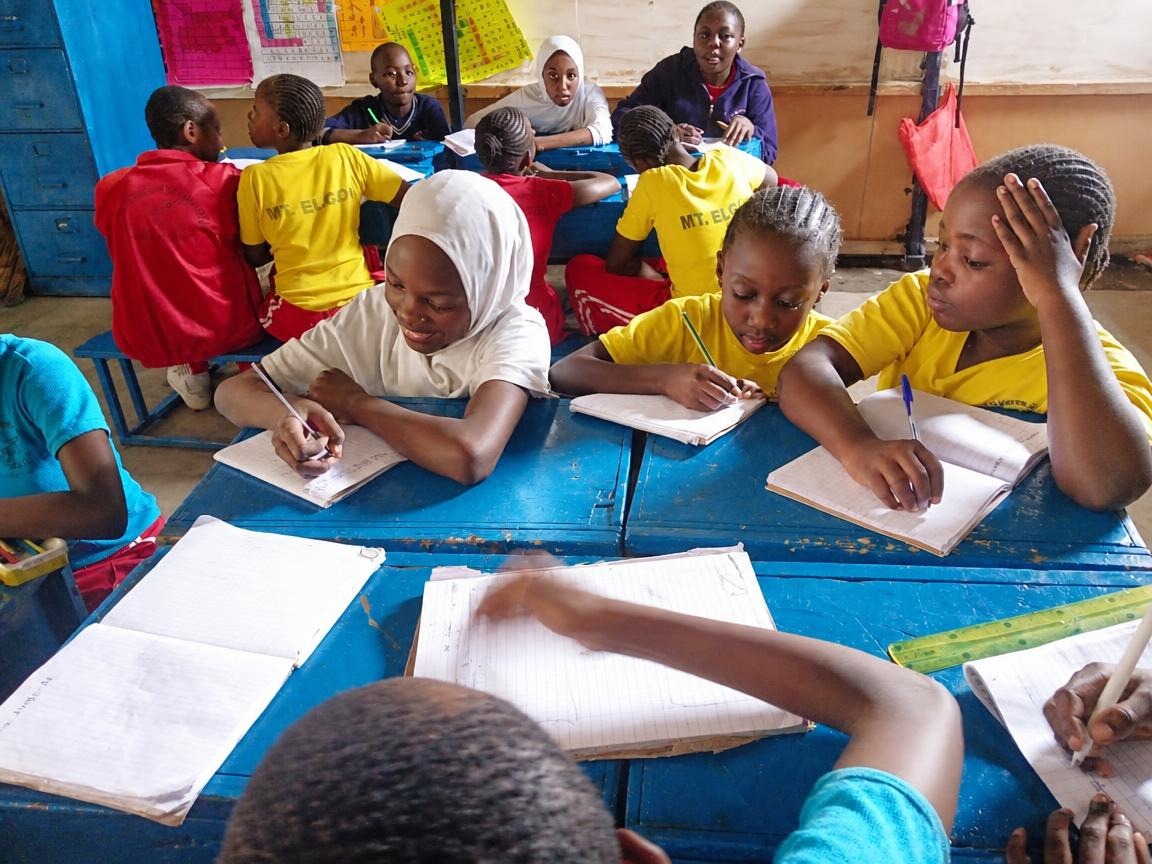
Imagine a classroom with no roof, half-built walls and no windows, with broken desks and pencils that are shared or missing altogether. Some children have to walk for kilometres through dust and heat to get there; others never make it because they have no school clothes or no way to travel. And yet, there is a spirit of struggle, of dreams and of the future. This is the reality in many corners of Africa.
1. The big picture: education as a shared challenge
Education is not only a fundamental human right, but also one of the most powerful tools for sustainable development. Yet the data show that many obstacles still need to be overcome.
- According to the UNESCO Institute for Statistics, some 118 million children, adolescents and young people in Africa are out of school.1
- In sub-Saharan Africa, only about half of young people of upper secondary school age (15 to 17) attend school.2
- Going to school does not always mean learning: according to the World Bank, nearly 9 in 10 children in sub-Saharan Africa cannot read and understand a simple text by the age of 10.3
- Gender inequality persists: sub-Saharan Africa is the region where young women face the greatest disadvantage in completing secondary school. For every 100 young men who complete it, only 88 young women do.2
- In Kenya:
- The State of Education in Kenya report (2025), produced by Zizi Afrique Foundation and Usawa Agenda, identified major gaps in school infrastructure, sanitation, laboratories, science equipment and the integration of digital technologies. At the end of 2024, only 21% of teachers in public junior schools had been trained in STEM subjects; 35% of schools did not have a single teacher specialised in these subjects, and only 48% of learners had access to laboratory facilities.4
- In April 2025, the Teachers Service Commission (TSC) told Parliament that public schools were short of nearly 98,000 teachers, and the State of Education report puts the figure at around 100,000 when all levels are included. The figure varies depending on the levels and institutions counted, but it reflects a serious staffing shortage as the new competency-based curriculum is rolled out.45
- Funding for public schools is also a challenge. According to the Kenya Secondary Schools Heads Association (KESSHA), in the first term of 2025 the government was due to transfer 11,122 shillings per secondary student but transferred 8,818, leaving a total shortfall of around 7.6 billion shillings. The National Treasury has acknowledged that budget constraints make it impossible to fully fund the planned amount per learner.67
2. Barriers to education
To understand the scale of the challenge, we need to look at the structural barriers that stop education from reaching everyone.
Inadequate infrastructure
Many schools operate in buildings that do not meet basic requirements: overcrowded classrooms, leaking roofs, unfinished walls, too few toilets or none at all, and no access to drinking water or basic sanitation. In Kenya there is, on average, one toilet for every 66 boys and one for every 62 girls — more than twice the ratio recommended by the Ministry of Education (30 and 25 respectively). This creates unhealthy and unsafe conditions.4 The Kenyan Ministry of Education’s first annual report on education quality (2026) also found inadequate or poorly equipped laboratories, overcrowded classrooms and dormitories, toilets in poor condition and water shortages in many schools.8
As enrolment grows, these buildings cannot cope. The rapid rise in student numbers has not been matched by adequate investment in school infrastructure.
Teacher shortages and quality of education
It is not only a question of numbers, but also of proper training. Many teachers lack the resources and support they need to teach effectively. There are also schools that operate without materials, books or teaching aids, often without technological support or reliable internet access.
This limits how much children actually learn. Having children in the classroom does not guarantee that they learn: in Kenya, only 4 in 10 Grade 4 learners can read and understand a Grade 3-level story in English.4 What is known as “learning too little” ends up having a strong effect on school retention: many children drop out because they see no clear results.
Distance, costs and practical obstacles
Many children live too far from school, and transport is not guaranteed. Some have to cross dangerous areas or difficult paths. Costs, however small — uniforms, books, school supplies, local fees or informal expenses — can be insurmountable barriers for families living in poverty.
Gender inequality
Girls are often the first to leave school: because of household responsibilities, forced marriage, teenage pregnancy, fear of travelling alone or a lack of suitable facilities for girls in schools (separate and safe toilets, appropriate spaces). Gender equity in education is therefore a key challenge.
Conflict, migration and environmental crises
In areas affected by armed conflict, displacement or climate crises (floods, droughts), schools stop, move or disappear. In 2024, floods caused by torrential rains in Kenya forced the government to postpone the return to school for the second term and to reorganise the school calendar, and damaged many schools.9
3. The transformative impact of education
If education is a challenge, it is also the most effective lever for change we have. Investing in education brings many benefits, both for individuals and for society as a whole.
Higher incomes and less poverty
Every extra year of primary or secondary education increases job opportunities and income. According to a study by economist Amory Gethin (World Inequality Lab), the expansion of education accounts for around 40% of the reduction in extreme poverty worldwide since 1980.10 UNESCO also estimates that if all adults completed secondary education, around 420 million people could be lifted out of poverty.11
Social cohesion and stability
Better-educated societies are better at resolving conflicts, have higher democratic participation and are less vulnerable to extremism. When citizens understand, express their views and act, the quality of government improves.
Health, gender and community well-being
Women’s education has a direct effect on the health of the whole family: according to UNESCO, a child born to a mother who can read is 50% more likely to survive past the age of five.12 In addition, girls who can continue their education have more opportunities to shape their own future and pass on health and knowledge to their families.
Innovation, technology and local capacity
Technology and innovation will be key to tomorrow’s Africa. But without a solid educational foundation, many countries will be left behind. Investing in ICT infrastructure, trained teachers and digital literacy opens the way to smart cities, local technology companies and connection with the global economy.
4. The example of Kenya and Nairobi: local challenges and opportunities
Associació Solidària Elimu Àfrica works with St. Elizabeth Integrated Learning Centre, a home and school in Nairobi (Kenya). This local reality brings the figures and challenges down to a human scale. Like many other urban and peri-urban areas, Nairobi is a place of contrasts: highly developed districts alongside extremely vulnerable ones. In large informal settlements such as Kibera, one of the largest and most deprived neighbourhoods in Nairobi, many families live in extreme poverty, with limited access to basic services and education. The school we work with is in Ruai, on the eastern outskirts of the city, and it is home to children who have nowhere else to live and who find shelter, food and education there.
Kenyan education faces not only a lack of infrastructure, but also a technology (ICT) gap. Many schools have no stable internet access or computer equipment, and according to the Ministry of Education the use of ICT in teaching remains low in most schools, even where some digital devices are available.8
It has also been reported that funding arrives late: the money for schools (capitation funds) is disbursed late, making it hard for schools to run normally.
For the school we work with, this means that completing the building is not just an architectural dream, but an urgent need. Without a roof, properly enclosed classrooms, safe toilets and furniture, many students will be unable to attend or will not have decent conditions for learning.
This project in Nairobi is, in essence, an investment in the future: that is why every metre built, every window fitted, every crack repaired, every chair and every book is so valuable. This school can become a local example of dignity, hope and opportunity.
5. How to mobilise solidarity and make the project happen
For this dream to come true, active participation from Mallorca and beyond is essential. This is where Associació Solidària Elimu Àfrica plays a key role: acting as a bridge between global solidarity and local needs.
Local fundraising strategies
Organising charity art exhibitions, craft markets, benefit concerts, school workshops and other cultural activities that raise awareness and funds. Something as simple as a charity pa amb oli (Mallorca’s traditional bread with olive oil) can bring families and communities together around a common cause.
Transparency and trust
It is essential that every donation has a visible return: sharing photos, reports and updates on the progress of the construction. Trust is what keeps solidarity going over time.
Local and international partnerships
Working with schools, local NGOs, Kenyan authorities and international agencies to make the best use of resources, ensure sustainability and avoid duplicated efforts. Education is a global challenge and requires cross-cutting collaboration.
Volunteering and technical support
Everyone can contribute: from translation services, drafting documents, web design or collecting materials to helping with logistics. Professional profiles in architecture, education, technology or community management are extremely valuable.
Outreach and awareness
Raising money is not enough: we need to inspire. Sharing stories, photos, videos and results encourages others to join in, multiplies the impact and creates a wave of solidarity that goes beyond a single project.
6. Looking ahead: a long-term vision
The home and school project is only the first step. Our vision is for this school not only to welcome children from the neighbourhood, but to become a hub for education and the community. With after-school programmes, adult education, technology workshops, health programmes and environmental education, it could become a driver of local change.
We also want the new school to be a model of climate resilience: built with suitable materials, with good sanitation, designed to withstand heavy rain or heat, and with environmental awareness. That way, the building will be a strength rather than a weakness, and an example of sustainability.
Encouraging the use of new technologies (digital inclusion) is also key: giving children access to computers, the chance to learn basic programming or to use digital learning resources (where connectivity allows) means investing in a generation able to face the 21st century with real tools.
Finally, we hope this school will be the first step towards extending the project to other communities in need in Africa, drawing on the experience and knowledge gained, and building an Associació Solidària Elimu Àfrica network that crosses borders and multiplies the impact.
If you have read this far, you share the belief that education cannot wait.
With your help, this school in Nairobi can stop being a dream and become a home full of light for many children.
Join Associació Solidària Elimu Àfrica. Help education grow, borders fade and solidarity turn into action.
Sources
- UNESCO Institute for Statistics (2025). SDG 4 Scorecard: progress report on national benchmarks in Africa. https://www.uis.unesco.org/en/publication/sdg-4-scorecard-progress-report-national-benchmarks-africa ↩︎
- UNESCO (2023). 250 million children out-of-school: What you need to know about UNESCO’s latest education data. https://www.unesco.org/en/articles/250-million-children-out-school-what-you-need-know-about-unescos-latest-education-data ↩︎
- World Bank (2023). What will it take for Africa to lead an education turnaround?, based on the State of Global Learning Poverty (2022). https://blogs.worldbank.org/en/africacan/what-will-it-take-africa-lead-education-turnaround ↩︎
- Zizi Afrique Foundation and Usawa Agenda (2025). State of Education in Kenya. Summary published by Insider Kenya, 17/07/2025. https://insiderkenya.com/2025/07/17/state-of-education-report-indicates-a-shortage-of-over-100000-teachers/ ↩︎
- Teachers Service Commission, appearance before Kenya’s National Assembly (April 2025). Reported by CBC Online. https://cbc.co.ke/tsc-lists-98281-teacher-shortage-in-junior-and-senior-schools/ ↩︎
- The Star (14/07/2025). Secondary schools heads: State owes us Sh18bn capitation money. https://www.the-star.co.ke/news/realtime/2025-07-14-secondary-schools-heads-state-owes-us-sh18bn ↩︎
- Citizen Digital. Mbadi defends controversial remarks on free education, maintains Gov’t can’t sustain full capitation. https://citizen.digital/article/mbadi-defends-controversial-remarks-on-free-education-maintains-govt-cant-sustain-full-capitation-n366973 ↩︎
- Ministry of Education of Kenya, Directorate of Quality Assurance and Standards (2026). Annual National Report on Education Quality in Kenya (financial year 2024/2025), pp. 5, 16 and 18. https://www.education.go.ke/sites/default/files/2026_MoE_National%20Report%20on%20Education%20Quality%20(1).pdf ↩︎
- Kenya Human Rights Commission (2024). The impact of 2024 floods on schools. https://khrc.or.ke/wp-content/uploads/2024/07/The-impact-of-2024-floods-on-schools-1.pdf · Nation. How State plans to recover ‘lost’ school days. https://nation.africa/kenya/news/education/-how-state-plans-to-recover-lost-school-days–4614084 ↩︎
- Gethin, A. (2023). Distributional Growth Accounting: Education and the Reduction of Global Poverty, 1980-2022. World Inequality Lab, Working Paper 2023/25. https://wid.world/document/distributional-growth-accounting-education-and-the-reduction-of-global-poverty-1980-2022-wid-world-working-paper-2023-25/ ↩︎
- UNESCO, Global Education Monitoring Report and UIS (2017). Reducing global poverty through universal primary and secondary education. https://unesdoc.unesco.org/ark:/48223/pf0000250392 ↩︎
- UNESCO. Education counts: towards the Millennium Development Goals. https://unesdoc.unesco.org/ark:/48223/pf0000190214 ↩︎